Friday, December 24, 2010

Merry xmas and happy new year!

I'm going away to visit my parents for the holidays and I'll be back next year. So I don't know if I'm going to update this blog this year. I'm going to sit inside and eat xmas food and candy, so there may not be much biking to blog about. So best wishes for the new year to all my readers, that is, me and Ms.Ding :)


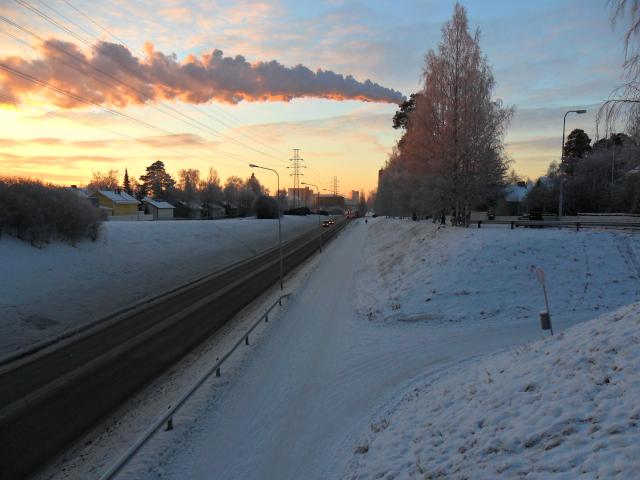
Sunset in november, about 16:00. The sun is just above the tree tops and would be visible if the camera was turned a little to the left.
A view from the railway bridge to the roads below. In the left, road for cars. In the middle, the bikeway. Also note the railing to stop kids sledding and adults slipping and falling down onto the road. The bikeway is about 2 m higher than the cars.

The smoke is coming from the combined heat and power plant (electricity to the grid and heat for District heating- basically a city wide central heating system) in Toppila. It's a powered by peat and wood and has energy efficiency of over 80%.

My poor bike, all frozen up!

Yesterday I had to go buy some presents. Very last minute shopper, that's me. :)

I threw some clothes on and went to find my bike. It was a cold day (-26C) but I was safe from frostbites because I have EST. I had left my bike outside the last time I rode it, instead of carrying it to the warm bike garage in the 
basement. There was some snow on the handlebars and the seat, but that was  quickly cleaned.

When I was cycling I noticed my bike felt a little 'off' and it took me a while to figure out the reason. At first I thought I had something wrong with the tires (like too low air pressure or something) because I felt a little unbalanced. It felt like the front tire was in a groove and I had to turn the handlebar harder than normal. Well, when I found out the reason I felt really sorry for my poor bike.

The grease on the bearings in the steering tube was frozen. There was a noticeable resistance to turning the handlebar. I could lock the brakes on the front wheel and lift the rear wheel up. The rear end of the bike stayed up in the air, instead of falling down. I wish I could have taken a photo if it, but there was nobody around right then.

There were a few other cyclists about despite the cold weather. I took some snapshots but they were not good so I'm not posting them. Bad lighting conditions and a little blurred. Usually I take several shots to see which settings work best. Not this time :) A metal frame camera is not perfect for cold weather. I doubt -26C is in the range of operation temperatures in the manual for the camera either. I don't even try to make cycling videos with my MD80 clone in the winter - its too dark and the battery has no juice in below -10C conditions.

Yes, the bike is in the garage again!

The EST for safer winter cycling

The EST is an advanced technological innovation for winter cycling. If you were cycling in the winter and the weather is cold, you could risk frost bites on your face because the wind chill effect makes it even colder. The obvious solution is to put more clothes and some kind of mask to protect your face from the cold. This is a hassle. And we all know that having to wear special gear like a helmet or a hiviz vest for cycling is not appealing to anyone.

The more advanced option is The EST. After years and years of scientific research, they came up with this innovation. Carefully designed in the laboratories of the tyre manufacturers, they make tyres which take full advantage of the special physical properties of the rubber: it is not elastic in cold. This means the EST tyres automatically increase the rolling resistance and thus force you to cycle slower when it is cold. And the colder it gets the harder cycling gets. A cyclist can have a good work-out while cycling almost at walking speed, with no wind chill effect at all! Awesome!

The red line is the risk of frostbites without EST. You can see how it rapidly increases. The EST compensates the effects of cold by decreasing the speed (blue line), so the risk stays at the same, low level no matter how cold it gets. 
The Energy Sucking Tyres increase the safety of cyclists by lowering their speeds when they are encumbered by many layers of clothing. For example, when cycling downhill to an underpass, the tyres suck energy so effectively that the bike can stop despite going downhill. Just think what could happen if a cyclist has so thick mittens in his hands that he can not use the brakes! Or the brake cables were frozen? The energy sucking tyres keep the bicyclist in control of his vehicle.

In fact, the Energy Sucking Tyres are even better than regular brakes. Just try braking on ice. As soon as the wheels lock, you are going to fall. But, don't worry. The Energy Sucking Tyres can function as ABS brakes! They will roll, but slow you down smoothly.

I'm sure whoever came up with this idea will be nominated for a Nobel price. It could be in the phycics category or in the medical category. Maybe even both!

Friday, December 17, 2010

segregation

In some countries (like the UK) there is a debate going about segregated bikeways. Should cyclists cycle on the road like cars or do they need segregated bikeways.

Obviously, I've grown with them so I find it hard to understand why anyone would like to cycle on crap lanes with cyclists dismount signs everywhere. Or cycle with cars, which can be dangerous for even an expert cyclist as you can see on the youtube videos. Definately only for the brave minority of people.

My input for all that debate can start by one picture:

A segregated train/bikeway bridge. 
Do you expect kids going to school to "share the road" with trains?

Pretty Pictures from Bike Bridges

Like many cities, Oulu was built where it was easy for people to travel to make some business. Oulu-river meant people could transport their barrels of tar to Oulu when they still used to have sail ships.

There are a couple of small islands where the river meets the sea. So there are a few brigdes connecting the islands to each other and to the mainland. Of course, some of these bridges are not meant for car traffic, but pedestrians and bicycles. The maintenance crews do drive on them to check the bikeways and remove the snow and grit them. In the first picture you can see one maintenance worker with a hi-viz vest doing his work.

I got a guy in a yellow hiviz vest in this shot. He's not a cyclist, but road maintenance worker :)

A beautiful sunset - about 1600hrs or 4 pm in late November.


Cycling chic in Oulu at -15C.

Wednesday, December 08, 2010

Bikes are like water

T-intersection of two bikeways. Shortcuts to the right.
This is what you see often: pedestrians and cyclists make their own paths. More often when the ground is dry so the shoes do not get wet and dirty (parts of Oulu is built on swamp) or if there is not a lot of snow. Pedestrians save a few steps by taking a short cut. Cyclists do not have to make such a tight turn if they take the shortcut.

I think even the tracks going left of the traffic sign are taking a little shortcut, ie. they are not on top of the pavement.

Bikeways in Oulu

I use the term 'bikeway' because it is shorter to type (cyclists like short cuts) and I can use it to cover all kinds of cycle facilities. I like it, it sounds to me similar to the "motorways" and "highways" meant for car traffic. It sounds like the bike is important.

We have about 550 km of bikeways. Most of them are multi-user paths. There are some cycle routes on quiet cul-de-sacs, where the car traffic is very light so they do not get in our way much.  I don't think we have bike lanes painted on the street anywhere in Oulu. They just dont work in the winter because of all the snow covering any painted street markings.

This is a shared street. It's also dead end street for cars.
I've read that in the UK they do not want to build paved cycle paths through parks. Here it's the opposite. Cyclists do not create traffic noise to spoil the parks. We build bikeways trough parks and other green areas.  They are often the shortest route between A and B, so it makes sense. Of course, as they are mosty multi-user paths, the pedestrians and dog walkers can enjoy the nature, too. I've not found the pedestrians, dog walkers, rollerbladers or mothers with prams to be a problem. On the routes I frequently cycle, the bikeway is wide enough so passing is no problem.

Dog walkers on a MUP on one of the islands.
Also the bikeway is a good term because the bikeways are not tied to the car roads. Non-through streets for cars and underpasses mean that the route to destination is (or it can be) different for a cyclists and a car driver. For example, from my house to a supermarket is about 1,5 km as the crow flies. By bicycle it's about 1,8 km. No traffic lights, three intersections with cars. By car it is 3,6 km and I think it is 9 traffic lights. Second shortest route is over 5km and has also traffic lights on it.  Ok, this is a very extreme example but explains why the bike is popular here in Oulu for short trips.